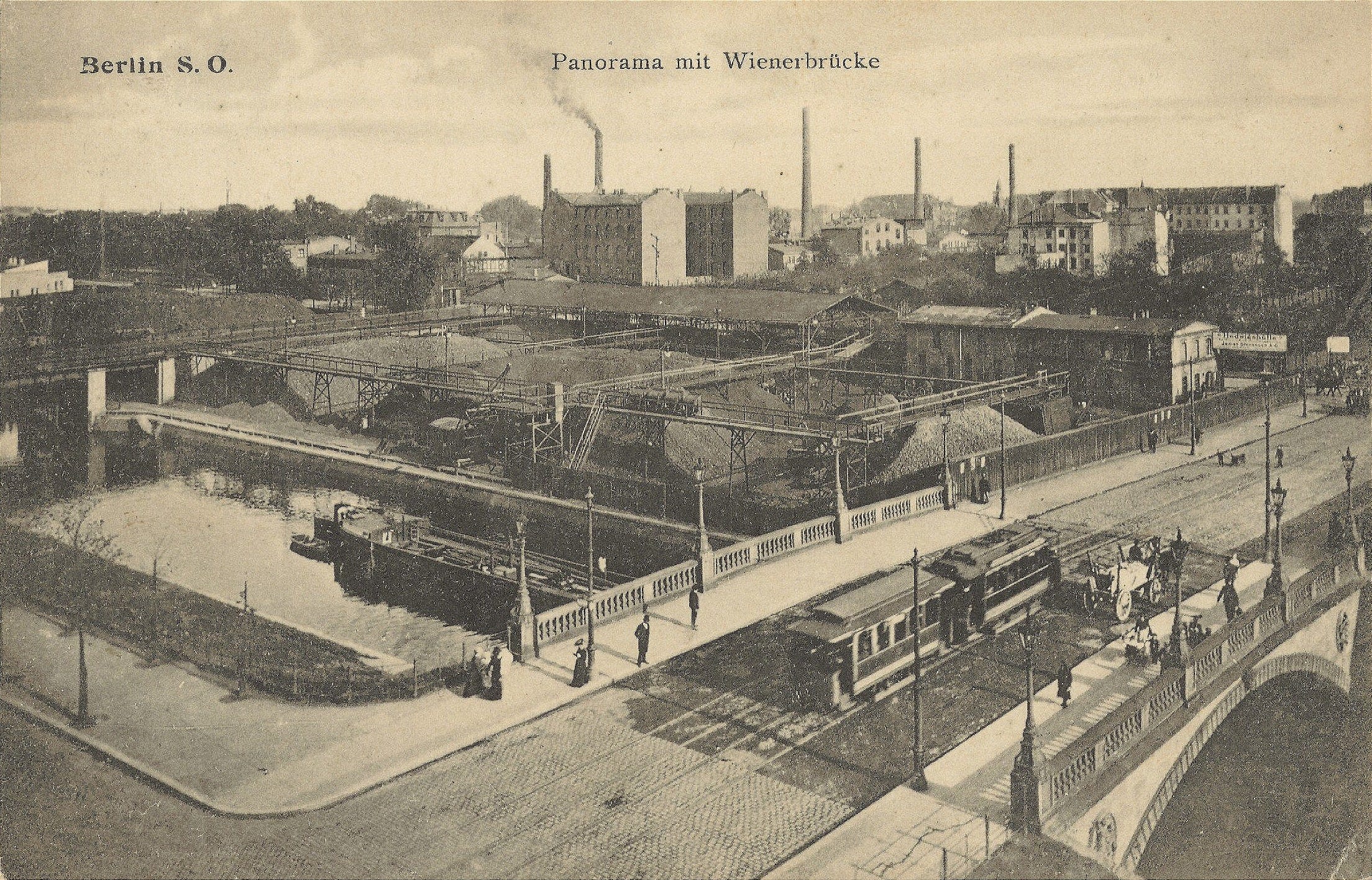
YOU ARE HERE: THE VANISHED WIENER BRÜCKE

Berlin’s Landwehrkanal, a vital waterway connecting the upper Spree within today’s Berlin-Friedrichshain/Kreuzberg with the lower Spree in Berlin-Charlottenburg, was built to both slow things down and speed them up at the same time.
The slowing concerned the Spree itself - the river was overrun by transport traffic required to sustain a growing metropolis. The speeding up referred to the transport itself: if bricks, apples and spare parts for machines did not have to be hauled along the meandering river, they would reach their destination easier and faster.

The Landwehrkanal, soon spanned by nearly 30 bridges, was a magnificent shortcut. Over the decades following its opening in 1850, these bridges multiplied and grew more and more elaborate - the canal was no longer seen as just a commercial waterway. With time it evolved into “a feature”.
Many of the Landwehrkanal spans still exist - even if in a slightly or completed new form (the Nazi troops could, sadly, be very thorough following Hitler’s “Nero-Befehl”). One bridge connecting two boroughs is, however, gone for ever.

Kreuzberg’s Wiener Straße, a long street connecting the busy Skalitzer Straße with Görlitzer Ufer (running along Berlin’s Landwehrkanal) used to end with a bridge. For nearly 50 years it spanned the canal connecting Eastern Kreuzberg (SO36) with Treptow.
Wiener Brücke, built in 1896, was erected 23 years after the street changed its name from rather dull Verlängerte Oranienstraße (Extended Oranienstraße) to that honouring the Austrian capital, Vienna. The choice was not accidental: Görlitzer Bahnhof, famous terminus railway station erected in 1866-68 within the boundaries of today’s Görlitzer Park, was where the first Berlin-Vienna trains started to bring eager travellers from Prussia to Austrian-Hungarian heaven.
As for Wiener Brücke, its own heyday was the year of its actual construction: in 1896 Treptower Park was home to Berlin’s Great Industrial Exposition. To provide as comfortable an access to it as possible, next to next railway stops and omnibus services, a well-frequented tram line crossed the bridge on its way to the exhibition grounds.

The span also connected Wiener Straße with what was then known as Straße Nr 4 des Bebauungsplannes, later named Liststraße, then re-named Graetzstraße. Since 1962 it has been known as west Treptow’s most popular street, Karl-Kunger-Straße.

The original Wiener Brücke shared the fate of many other Berlin spans: in April 1945 it was blown up by the Wehrmacht to slow down progress of the approaching Red Army. A wooden footbridge would be built to replace it after the war in 1957 in what became the inner-city border zone: it would be a “recycled” footbridge from another manmade Berlin waterway, the Teltowkanal.
Its western end stood in West Berlin while the eastern one in the Soviet Occupation Zone aka East Berlin. From 1961 the bridge - itself property of the DDR - effectively and rather symbolically ended bang at the Berlin Wall.
It would stayed unused for another four decades. In August 2000 the remains of the by then badly weathered wooden footbridge vanished for good.

To find the remains of the original bridge today you have to travel to Berlin-Heiligensee, a locality in the north-west of Berlin’s district of Reinickendorf.
You will find them at the local cemetery: two bas-reliefs made for Kreuzberg’s Wiener Brücke in 1895 by Wilhelm Wandschneider were fished out of the Landwehrkanal and installed there as Memorials to the Victims of the Second World War.
If you look at them carefully, you will notice an interesting similarity: Windschneider used two Pergamon Altar motives for his work. He used “Alcyoneus and Athena” (where the goddess prevents the winged giant from being saved by his mother, Gaia, emerging from the ground) featured on the East Frieze and one of the Erinyes, possibly Nyx, about to hurl a vessel filled with snakes at another giant. You will find the latter motive on the North Frieze.

Otherwise, you can sneak along the eastern bank of the Landwehrkanal - between the embankment and the wooden fence of Wagenburg Lohmühle existing within the former death strip since 1991 - and inspect the embankment itself. Not far from the old railway bridge known as Görlitzer Brücke you might still be able to find the remains of the vanished bridge abutment. So happy hunting! And, of course, strolling.