YOU ARE HERE: HERR BARTELS SHOOTS
Strolling Through Vanished Berlin
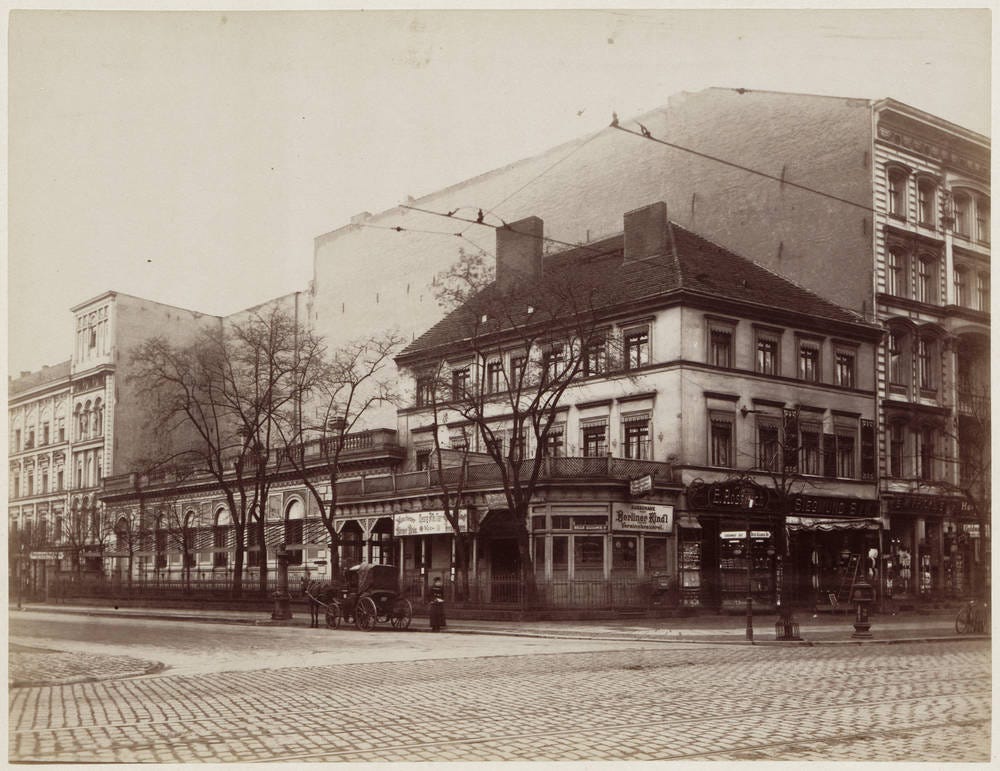
Travelling in time requires not only outmost precision while setting your parametres. It is also about being able to accept that fact that where you have landed might be far superior to where you have started from - and to resist the urge to stay. For as peaceful and enchanted this street corner might appear to you, it is going to go through some rough times beginning less than four decades later.
You are looking at the corner of Belle-Alliance-Straße and Teltower Straße. Neither of the two is mentioned on current Berlin maps, though: they are called Mehringdamm and Obentrautstraße respectively. The street corner, just south of Hallesches Tor in Berlin-Kreuzberg, has changed a lot.
The photographer, brilliant Georg Bartels - another Berlin artist who gave us images of the city we would otherwise never get to know - took out his camera on what feels like an autumn or winter day in 1907. Wise choice of the season - had he come in summer or late spring, the leaves on those trees would have well obscure the building.
He photographed a popular restaurant run by one Georg Pfeiffer, who served two well-loved beer sorts at the time: Berliner Kindl and Münchener Bürger Bräu. A large hall inside the lower flat building was particularly full of the days when the royal military manoeuvers took place on the Tempelhofer Feld twice a year. Both troops and the excited Berliners had to pass Herr Pfeiffer’s etablissement on their way to and back from the event. So did the Kaiser.

But Bartels’ photo was already its swan song. Soon afterwards the buildings would be demolished and replaced by the new assembly hall, the Kammersäle, with the seat of Berlin's Handwerkskammer (Trade Corporation).
Today's building continues to house the Handwerkskammer but seems to be tiny in comparison with its old seat. That is because the plot got smaller, too. In the early 1970s, Mehringdamm - which by now reached what was a dead end (the Berliner Mauer and Checkpoint Charlie were not far so traffic almost literally hit the wall there), had its northern end moved to the west.

This way, drivers could continue across the Landwehrkanal and down Stresemannstraße towards the Tiergarten and the rest of West Berlin. To make sure traffic flow run smoothly, the old Blücherstraße was also extended westwards, cutting through what used to be the old cemeteries known as Friedhöfe Vor dem Halleschem Tor. Obviously, you cannot run such a large-scale project without tearing down a thing or two.
That’s how the old street corner photographed by Bartels at the beginning of the twentieth century corner became a junction of Mehringdamm and Blücherstraße. Not something anyone would have considered possible (or come to that, necessary) in 1907.
If you enjoy learning more about Berlin’s less trodden paths and are in Berlin or planning to visit, you can enjoy a pleasant audio-walk through this area (starting further south the old Belle-Alliance-Straße and up the Kreuzberg Hill, as well as through the leafy Viktoriapark) with me as the guide in your ear. My GPS-controlled audio-tour “Templars, Bunkers and Prussian Glory: A Walking Tour of West Kreuzberg” is available via VoiceMap. Just download the app, then the tour, pop your earphones on and go!