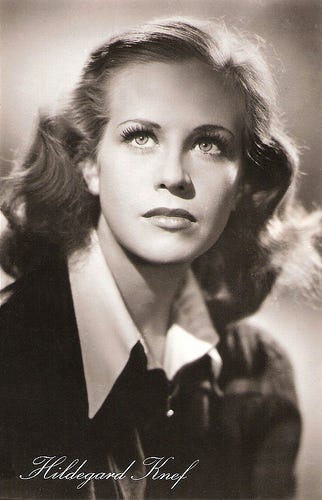
THIS WEEK IN BERLIN: HILDEGARD KNEF - THE STAR IS BORN
28 December 1925
Ella Fitzgerald described her as „the best singer without a voice“. Her mother pronounced her “talent-free”. And during her test performance at the State Film School in Babelsberg her typical Berlinerisch pronunciation and the habit of swallowing word-endings made the examiners cringe.
Physically, she did not do much better either: mouth too wide, nose too big and that hoarse, sonorous laughter that could raise the dead. Yet despite all those apparent shortcomings, Hildegard Knef, who never claimed to be a talent or a beauty, became a head-turner, a star and a legend. And not only in Berlin.
Born exactly a century ago - in 1925 - in Ulm to a mother with whom she would have a complicated relationship to say the least, at 14 Hilde would allegedly need a nose and jaw-bone surgery as a result of her mother’s “discipline measures”.
Very early on she also lost her father: he died – officially as a result of tonsillectomy, although a far less respectable cause of death (syphilis) could not be excluded either – when Hilde was only six months old.
The young mother with Polish and East Prussian roots, left Ulm behind and moved to Berlin to be closer to her father. But instead of moving into Karl Gröhn’s Frobenstraße flat in Berlin-Schöneberg, Hilde’s mother found a small place of their own albeit within the same district: they moved to Sedanstraße 33. A couple of months later they swapped it for a two-room third-floor flat at No. 68. Sedanstraße is called Leberstraße today, a lovely quiet, former working-class road in a neighbourhood known as Rote Insel.
Coincidentally, in 1901 another fabulous Berlin star was at home in the very same street just one street number further down the road: Marlene Dietrich lived in today’s Leberstraße 69.
Their paths would cross again in the future but more on that in a moment.
Meanwhile, at the age of seven, little Hilde contracted polio and developed articular rheumatism – the recovery took a long time and her health would remain an issue. More or less at the same time Hilde’s mother re-married but the stepfather the girl gained, a master shoemaker Wilhelm Wulfestied, never adopted her and would never become an ally.
The family re-settled to Berlin-Friedenau, to Bernhardstraße where Wilhelm opened a shoe-shop. Hildegard and her mother were both involved in its running. The birth of Heinz, a step-brother who needed particular care and attention due to his inborn heart-condition made mother and daughter drift further apart.
Knef’s life seemed to have had taken a turn for the better when she began her education as an animated-film illustrator at a school run by UFA, or Universum-Film Aktiengesellschaft – legendary German film-production company. Knef, who displayed quite a talent at drawing people as a small girl of eight, seemed to possess the necessary skills.
But these were not the only skills she had. Having grown up in the days of cinema’s ascent from a form of entertainment to a form of Art as well as a factor forming both tastes and political views (it was 1943), it didn’t come as a surprise that soon she, too, wished to join the film crowd. Hildegard Knef was determined to build a career in acting and moved on from her drawing desk to a place where she would learn the tricks of the trade: she joined an acting school near the film studios in Potsdam-Babelsberg.
Knef was young, blond, attractive and outspoken. A walking blueprint of a perfect “German girl”, highly praised by some commentators at the time. She quickly attracted the attention of influential men from the UFA universe and soon afterwards began her affair with a rather dashing head of a big Nazi film production company, TOBIS Film, Ewald von Demandowsky – an NSDAP member as well as married father of young kids. A man whom she fondly referred to as “Mischa”.
Allegedly, von Demandowsky was not the highest-rank Nazi who found Knef attractive. One Joseph Goebbels, a famously fond of attractive young actresses, wished to get to know her better and even issued a private invitation to his very private house at the Brandenburgian Bogensee. Perhaps luckily for the young Hilde, the woman in charge of the personnel department at UFA, Else Bongers – who had supported her before and who knew what kind of private meetings the Bogensee villa could offer p– managed to stall his plans.
By that time Hildegard Knef had already played small parts in at least two films. However, in vain would you look for her on the screen when watching the 1944 musical drama about Clara and Robert Schumann, Träumerei or “Dreaming”: her original film debut was thwarted in that the scenes she had played were simply removed from the reel. Goebbels is said to have strongly disliked the film – so much so that it almost got binned. It is uncertain whether there was a causal relation between Knef’s rejection of the “private invitation” and her debut being stalled but one can speculate.
Today, to see her actual screen debut you have to watch the 1944 film Die Brüder Noltenius which premiered on April 7, 1945 – as the Nazi own Götterdämmerung (Wagnerian “Twilight of the Gods”) was very much in progress. The latter was also the reason why Knef’s next film, Frühlingsmelodie (“Melody of Spring”), where she was entrusted with the rather unspectacular part of “The twin without a mole”. The premiere had been scheduled for 1945, but, for obvious reasons, the production never had its official opening.
The film often named as her debut is Unter den Brücken (not released until after the war): Knef features in it as the “Girl in Havelberg”.
The crew were filming between May and October 1944 with the Second World War rolling closer and closer to Berlin and the Havelland, a beautiful Brandenburg region where they worked at the time. Soon enough the main front of that war reached both the Havel and Berlin.
At that point Knef and her lover, von Demandowsky, left the latter’s Berlin-Dahlem villa (its actual owner, department-store director Alexander Konitzer, was forced to sell it in 1939) and hand in hand tried to flee the city prior to the Red Army soldiers’ arrival.
The two attempted to escape during the Battle of Berlin by joining the “people’s troops” – the Volkssturm. Knef pretended to be a man and the two ended up arrested by Polish troops.
Imprisoned in a POW camp with von Demandowsky and with 40,000 other German soldiers, she would eventually gain release. But “Mischa”, the now former powerful head of TOBIS Film, soon got re-captured. This time by the West Allied troops. His big wartime “achievement”? Under von Demandowsky TOBIS Film produced a film immediately banned by the Allies and today counts as a particularly vile piece of Nazi propaganda aimed at justifying mass-annihilation of those categorised as “unworthy of living”: TOBIS launched the 1944 Ich klage an (“I Accuse”), a film commissioned by Goebbels and advocating murdering the ill, the weak, the “redundant”. Ich klage an was created to pave the path towards wide public acceptance for the Nazi euthanasia programme later known as T4 (from Tiergartenstraße 4, the address of the body in charge of the officially ordered murders of hundreds of thousands of mentally and physically disabled people, including very young children).
Ewald von Demandowsky was put on trial and executed in 1946. Whether she wanted it or not, Hildegard Knef’s war-time biography was in itself a ready-made film script with huge Hollywood potential.
Perhaps it was also one of the reasons why Hollywood caught up with her in 1948 when David O. Selznick, signed her up for his legendary film production company. She moved to the United States with her young American husband, Kurt Hirsch, whom she had met as one of the Allied troops stationed in Berlin. Hirsch’s Jewish family arrived in New York from Prague and they were understandably disturbed by Kurt’s choice of a bride. As much as they loved their son, it was hard for them to overcome their negative feelings towards her. Yet Kurt and Hilde hoped for the best.
There was another problem: Selznick paid Hilde 250 dollars per week and even financed six hours of English lessons daily but at the same time he hardly cast her at all. Not easy for someone as thirsty for fame and as determined in her acting ambition as the young Miss Knef - and hardly acceptable for an actress with some film and stage record back in Germany.
At least New York brought her together with another German cinema legend from Berlin and a fellow Schöneberger, Marlene Dietrich. The two quickly struck a joyous friendship and soon Knef would be walking in Dietrich’s shoes – literally so as Dietrich equipped her younger colleague with plenty of high-quality hand-me-downs.
Knef followed in Dietrich’s footsteps as an artist, too. The song Ich Habe Noch Ein Koffer in Berlin (“I still have one suitcase in Berlin”), a paean to a beloved city that one always returns to regardless of where you go, would be performed by both.
Even though in the US she was stuck in the Selznick limbo, in Germany Knef’s name had already become a brand. In 1946 Knef was spotted by Wolfgang Staudte and landed the main female role in the first German film produced after May 1945: in the haunting Mörder Sind Unter Uns (“The Murderers Are Among Us”), filmed partly in the still smouldering ruins of Berlin.
In the film you can see, among others, the now demolished – and then in ruins but still standing – historic Berlin railway station, Stettiner Bahnhof. It is the same station where Knef’s character, Susane Wallner, arrives back in Berlin after having been freed from a Nazi concentration camp.
The film was a Soviet Sector production and Knef would go on to work for DEFA, the East German state-run production company, in the future as well. Unbeknownst to many, she also provided German dubbing for many USSR cinema hits.
Knef’s star was quickly rising: the 1948 Film Ohne Titel (“Film without a title”) brought her the main prize at the Film Festival in Locarno, the Grand Prix in Milan and a year later the German Bambi Award. Hilde’s face was on the cover of the “Stern”, the “Spiegel” and even the “LIFE Magazine”. She was everybody’s darling.
That is, until Die Sünderin – a romantic drama about tragic, doomed love – was released in 1950.
What followed can only be described as a witch-hunt: her brief nude scene, the first ever in the history of German cinema, led to barricaded cinemas, bans on the film all over Germany and abroad as well as to legal suits before the Bundesverwaltungsgericht (Federal Administrative Court of Germany). For both the church and the prude German society she was suddenly the public enemy number one. To quote Knef herself in 1959: “Not even Hitler got such bad reviews.”
She was particularly infuriated by one comment from the Bavarian Prime Minister who demanded that “if such films are made using the state’s money, then it is high time we did something against the moral deprivation of our youth.” Knef’s response was as fast as it was straightforward: she reminded everyone that such crass statements “only six years after the war, the concentration camps and the rapes” are not only tasteless but short of Machiavellian. Soon afterwards she left Germany again and took US citizenship.
Hated by some but still loved by many (again something she and Marlene Dietrich has in common), Knef visited Berlin on a regular basis. After the first music album she released in the 1950s, Ein Herz ist zum Verschenken (“A heart to give away”) – that she provided lyrics for – the German audience fell in love with her imperfect, raspy voice. Or perhaps it was her extremely warm and direct, very personal way of singing?
The Americans appreciated it, too: until today Hildegard Knef is the only German ever to debut on Broadway. Between 1954 and 1956 she acted and sang in Cole Porter’s play “Ninotschka” (otherwise known as “Silk Stockings”). The same role that catapulted Greta Garbo to the cinematic Olympus before the Second World War (thanks to another famous Berliner, by the way: the film director Ernst Lubitsch). Cole Porter would have Knef sing more of his songs: as many as three of them in the 1952 adaptation of Hemingway’s “Snows of Kilimanjaro”.
In 1957 Hildegard Knef returned to Germany: she walked out on Hollywood and broke her contract with the Fox Studios. Selznick bought the rights to film Cole Porter’s “Ninotschka” but Knef was banned from playing the part that had won her the Broadway audience. Her being German was one of the reasons – understandably, so soon after the war and the unspeakable horrors of the Holocaust, she was not welcome by many American Jews.
So back to Berlin it was. After all, like so many famous Berliners who were not born in the city, Knef was a true Berliner Pflanze. or a “Berlin plant”: a local term for a born and bred Berliner. By the day of her death at the age of 77, she had lived at sixteen different addresses in the city: in Schöneberg’s Rote Insel (Red Island) neighbourhood; in Friedenau in Bernhardstraße (the house does not exist any more and neither does this part of the street – it was demolished to make room for the city motorway). She also lived in Zehlendorf, in Alexander Konitzer’s old villa in Dahlem, in Grunewald and, of course, on Ku’Damm. At the “Kempinsky Hotel” at 27 Kurfürstendamm she spent six months in 1975 during the filming of Hans Fallada’s book “Everyone Dies Alone”. Her portrayal of Anne Quangel, an every-woman who together with her husband starts her own rebellion against the Nazis, is quite unsurpassed until today.
Coincidentally, it was not the first time when she met her film partner, Carl Raddatz, on screen. The two appeared together in Unter den Brücken. During the war Raddatz had a flourishing film career at UFA. You will find his name among the cast of at least three straightforward Nazi-propaganda films. Yet in 1975, they created a moving and deeply convincing portrait of everyday Germans trying to oppose the warmongering and the terror.
Hilde Knef, or Die Knef as she was known later in life – an honour reserved for very few Germans and equal to having a “von” slapped before one’s name – an actress, chanteuse, author and a fabulous big-mouthed Berlinerin, died in 2002 . She was buried at the Waldfriedhof in Berlin-Zehlendorf. You might want to go and visit, if in town.
Allegedly, now and then the plot No. 039/685 still reverberates with her hearty laughter. Some report hearing a quiet rendition of a song Berlin Dein Gesicht Hat Sommersprossen (“Berlin, your face is full of freckles”). Whether any of these are true, we cannot say. But if surely pays to go and check.
Thank you for reading Berlin Comoanion. If you enjoy these stories, please follow and share. You can also buy me a coffee🌞