THE CROWN AND THE CHEESE BELL
The Reichstag Building

It took nearly a decade to complete Berlin’s Reichstag building, the seat of German parliament. And no wonder: even the body in charge of selecting its architect could not agree on whom to employ and which design to go for. Their finalist, architect Paul Wallot, beat no fewer than 189 competitors to the title!
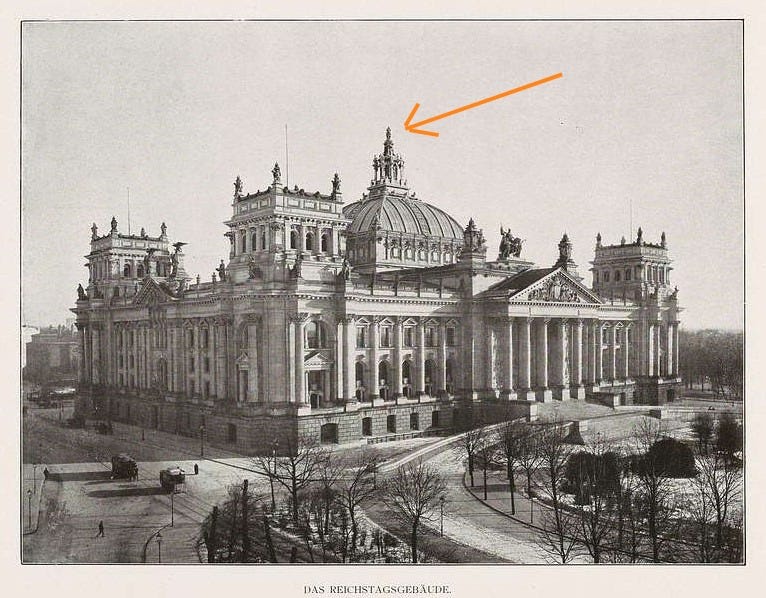
The new Reichstag building (the word Reichstag itself refers only to the highest parliamentary body as such but is often used to speak of its seat) was opened in December 1894. Kaiser Wilhelm II - not a fan, to put it mildly - attended the ceremony but afterwards, in a letter to a friend, described the new parliament building as “Reichsaffenhaus”. His Imperial Majesty - with his usual tact and respect for public administration - compared the MPs to a bunch of monkeys in a zoo cage.
Still, the building turned out to be imposing but not overbearing. Its massive dimensions made more human by the open location, the gentle bend of the river and the surrounding park (Tiergarten).
However, Berlin being Berlin, some gentle mocking was a must. And so, the exquisite steel-and-glass cupola designed to provide illumination to the assembly room below, was quickly dubbed “Käseglocke“ (cheese bell) or, alternatively, “Pickelhaube”: traditionally, cupolas were reserved for palaces and cathedrals. so this one was seen as a direct smack in the imperial face.
But even though the relationship between the Parliament and the monarch could hardly be described as loving, both sides knew who was the boss in the end. That’s why the architect and designers made sure to make that clear.
The beautiful Reichstag cupola carried an element traditionally referred to as the lantern - it would, indeed, be illuminated on special occasions. Look at from the ground level it was difficult to see the details. But thanks to a couple of texts illustrated with top-quality photos and published by the Blätter für Architektur und Kunsthandwerk between 1888 and 1894, we know that the lantern crowning the Reichstag was itself topped with a Kaiserkrone (Imperial Crown) supported by four pretty determined-looking herms.
The crown was nearly two metres tall and rested on a base measuring 3.63 metres in circumference. The uppermost edge of the cross on its top rose 74.8 metres above the plaza - Königsplatz - below. Why it mattered?
Because the royal palace, the Stadtschloß, further down Unter den Linden, measured “only” some 71 metres.
It seems that Wilhelm had another reason to be displeased: the Reichsaffenhaus went one up.