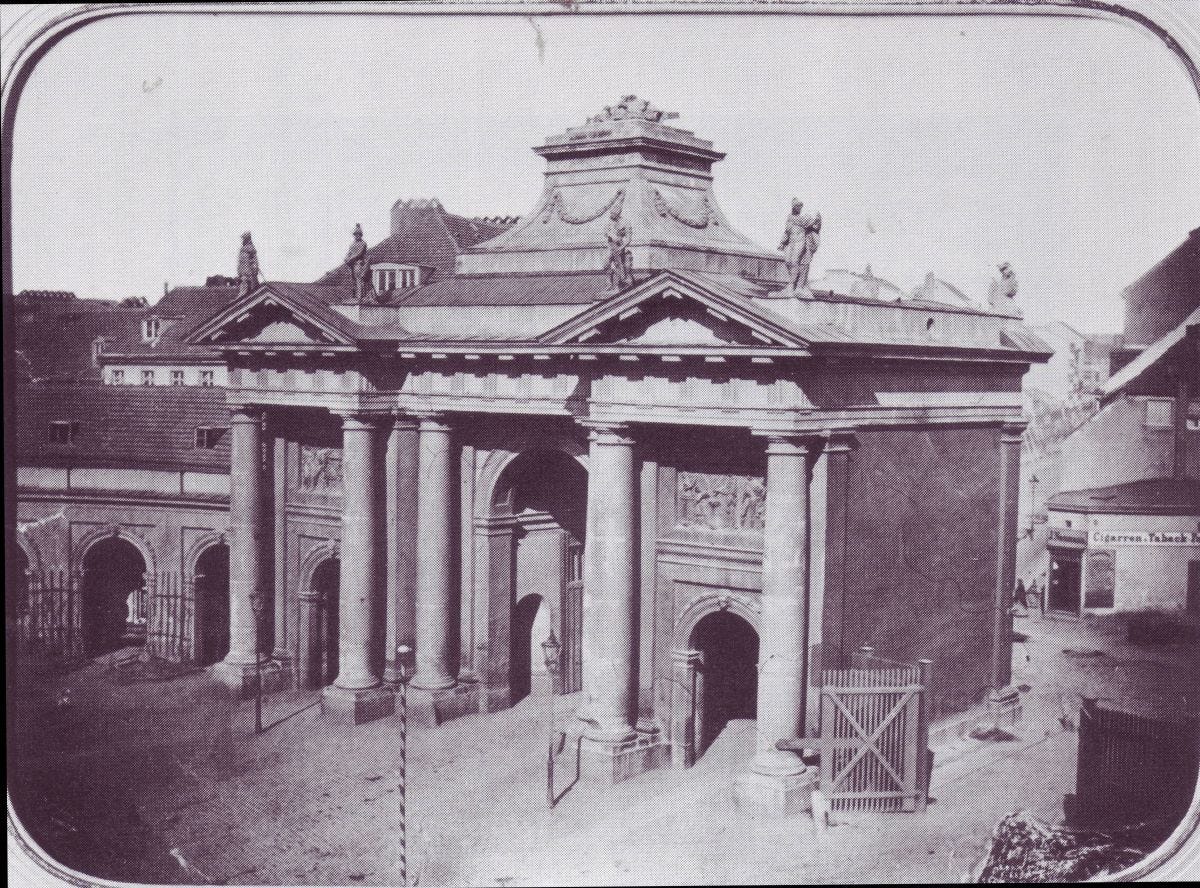
THE BERLIN WALL OF 1842: VANISHED CITY GATES

“Back then the city was still surrounded by a wall and right outside almost all of the city gates lay meadows and fields. That was, naturally, also the case with the ‘Anhaltstor’.
Berlin’s city gates were generally kept very basic; most of them were fitted with just a simple iron grid. One of the prettiest as far as its architecture went - not counting Brandenburger Tor - was, however, Rosenthaler Tor. It had three portals, with the larger central one for wagons and horse-riders; flanked by two smaller ones for people travelling on foot.
Next to one of them there stood a small building, housing the excise and customs office (just as was the case with all Berlin city gates). Next to the other portal soldiers guarding the gate had their station. (…)
It was customary back then for the Rosenthaler Tor guards to step outside and present their arms whenever, to the beat of a drum, a body was being transported to Sophien Cemetery in Bergstraße. That’s how they honoured to the deceased.”
From the memoirs of Agathe Nalli-Rutenberg (here the year 1842).

Between 1736 and the late 1860s Berlin was surrounded by a Stadtmauer - a city wall. This initially 14-kilometre long - later expanded to 17 kilometres - wall was also known as Akzisemauer (Customs and Excise Duty Wall), which reveals its two main functions: taxing incoming goods and controlling traffic in and out of the city.
But the eighteenth-century Berlin city wall had an additional role to play: to prevent Prussian soldiers, many of whom had been forcefully conscripted and stationed in Berlin with local families (neither side could refuse to accept the arrangement), from absconding and returning home. Once their absence was noticed or plans revealed while the deserter was already trying to leave the city through one of the gates, cannons were fired to alert the posts around the city to keep a lookout.
But Anhaltstor (Anhalter Tor) in whose vicinity (just outside the city) Agathe Nalli-Rutenberg lived as a child was never used for that purpose…
Why? Because it was only built in 1840 - to shorten the way from Berlin’s centre to the new railway station erected on the old bleaching fields and gardens beyond the wall: the original Anhalter Bahnhof. The railway company paid for it.