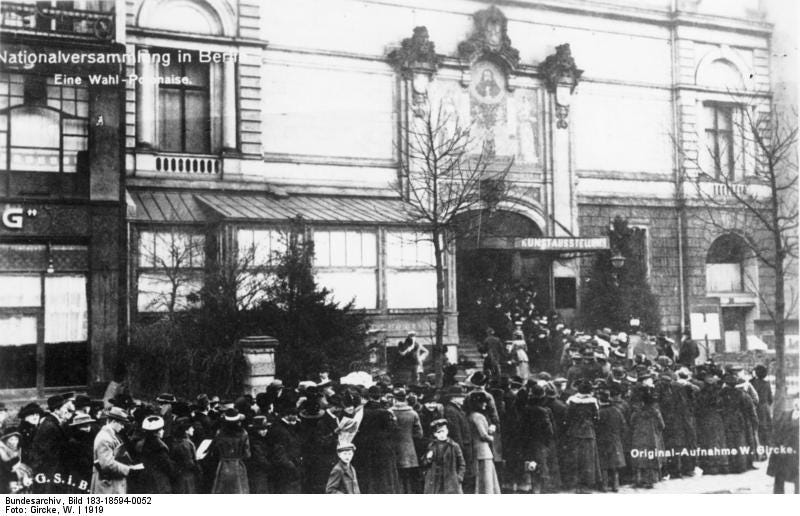
LADIES’ FIRST: GERMAN WOMEN VOTE
Today in Berlin: 19 January, 1919
On this day in 1919 some 15 million German women from the age of 20 voted for the first time in history.
Granted the suffrage (right to vote) on November 12, 1918 - only three days after Kaiser Wilhelm II’s abdication and the birth of what would become the Weimar Republic - some 80% of female voters made use of it by casting their ballots.
Compared to other countries, German women’s suffrage movement was a late- bloomer (also because Germany itself was at first a cluster of independent kingdoms and duchies). But it gained momentum in the 1890s and produced many prominent activists.
One of them, Marie Juchacz (the mother of AWO or Arbeiter-Wohlfahrtverband- „Worker‘s Welfare“ - workers’ self-help organisation which is active until today), was the first woman ever to speak before the National Assembly. She held her speech two weeks after the opening of the session in Weimar by Friedrich Ebert and exactly a month after the first election with women as active voters, on February 19,1919.
In terms of female enfranchisement, Germany might have been behind such countries as New Zealand (1893!), Poland, Denmark or Finland, but the reaction in many conservative German newspapers or magazines was the same as all over the world. Here’s the cover of a satirical magazine, Der Kladderadatsch with a cartoon entitled "Damenwahl" (Lady's Choice). Needless to say, punching - traditionally - low.
German women's right to vote and their participation in the 1919 election mean that the number of legitimate voters in the new state grew by 20 million.
Their passive right to vote lagged sadly behind. Also because of an anti- campaign led by groups such as Bund zur Bekämpfung der Frauen Emanzipation (German anti-feminist organisation established - the irony, I‘m sure, will not escape you - in 1912 in… Weimar). So it was, in a way, bordering on farcical that among the very first women to become German MPs through the newly won right to vote were also fans of the Kinder-Küche-Kirche status-quo preservation.
Not surprisingly, the latter belonged mostly to conservative (even ultra-conservative), often reactionary, monarchy-mourning middle- and upper-class groups, who once the republic solidified and the women’s vote became an undisputed fact, drifted more and more in the direction of church-fundamentalism, political far-right and eugenics. Features which were soon to make them supporters and followers of the new party in charge, the Nazis.
Thank you for reading Berlin Companion’s Berlin Calendar. Please comment, follow and share. You can, of course, also provide me with the necessary caffeine shot by clicking the button below - and many thanks to all of you already supporting the show:-)