
BREWING YOUR OWN - A BERLIN TRADITION
Painted Berlin

In 1895 Hans Baluschek, a brilliant Berlin artist who was very much into social realism, completed his painting “Hier können Familien Kaffee kochen” (Families can brew their own coffee here). A group of women - neither young, nor particularly attractive (and why should they be?), some of them seemingly not even quite enjoying the moment - are sat around a table in what feels like an outdoor café or a Biergarten, drinking coffee and eating Zimtschnecken (cinnamon rolls).
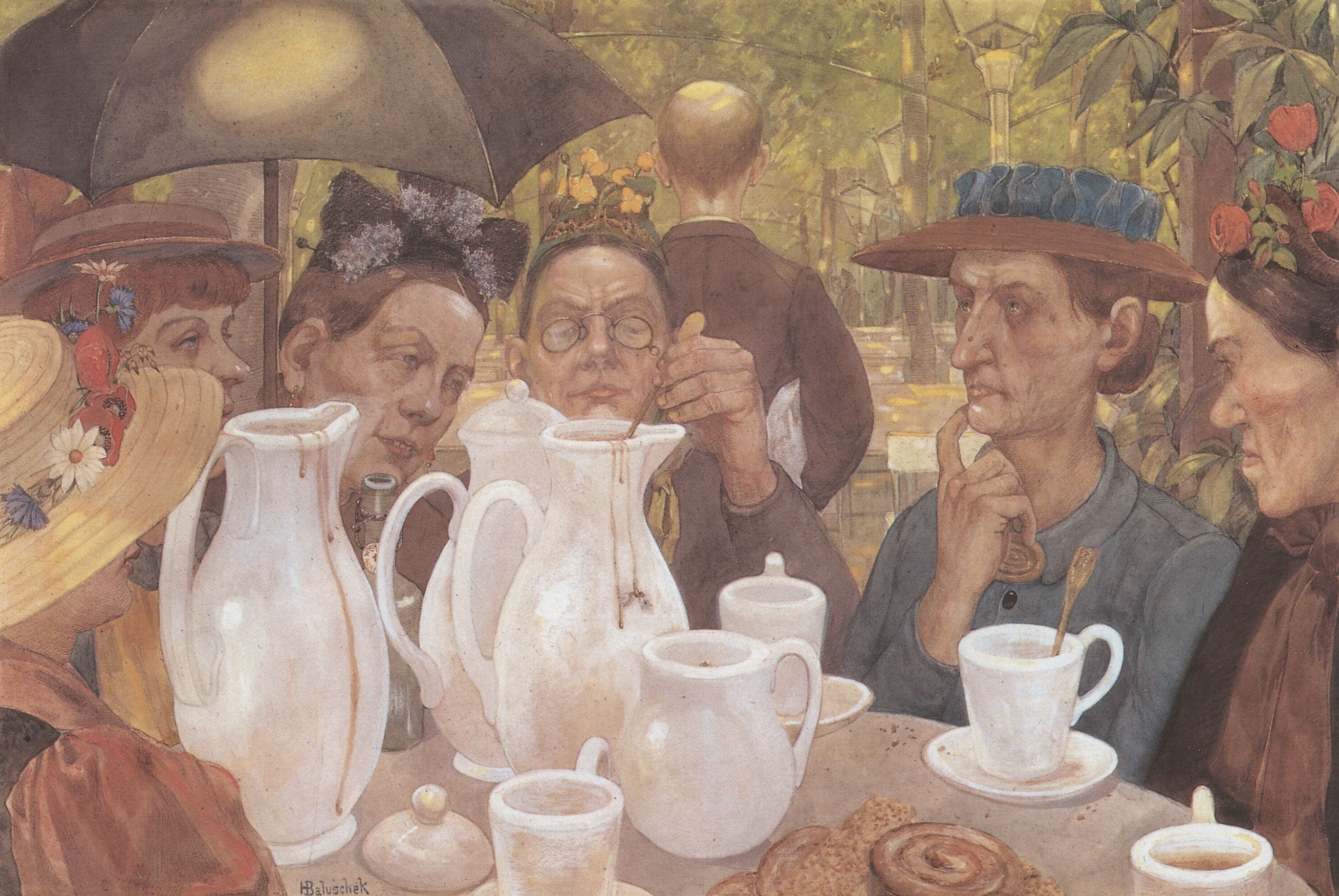
It’s a warm summer day, patches of sunlight dance on the tables and chairs behind them, and one of the group is slowly and carefully mixing coffee in a tall coffee-pot with a spoon. To make the coffee powder sink faster to the bottom of the pot and allow the ladies to enjoy another cup - out of three coffee pots on the table, one feels to be empty, the coffee inside another one is still brewing and the group seem to be looking forward to drinking from this one.
But why bother? Why not order ready-made coffee in those pots instead?
Here is why. The scene depicts an old Berlin tradition, which was born by the end of the eighteenth century and started with Friedrich The Great inviting Saxon settlers to Berlin and Brandenburg.
The settlers were needed to help boost Prussia’s economic output - the king believed in his land becoming a tad more self-reliant in this respect. Make your own food, grow your own grains, weave your own silk: Friedrich II famously tried to establish silk-weaving industry in Berlin and around it, mostly to save money on preposterously expensive garments but also to sell said garments - if produced by Prussia - to other eager buyers. And, in a nutshell, it did not work out (topic for another story).
The Saxons who settled in Treptow quickly noticed how popular their area was with Sunday visitors from Berlin. And what did day-tripping guests need? Something to eat and something to drink. It did not take long for the settlers to start inviting Berliners to their gardens and orchards, and offering them a small bite and simple beverages. Beer, Schnaps and coffee. And this is where a conflict enflamed.
The place, Vorwerk Treptow, already had at least one well-functioning place known as “Spreebudike” (Budike is a Berlin word for a small stand). And its owner as well as other local food-and-drink sellers were not happy about the competition. So they complained to the authorities.
The authorities looked into the matter and decided that - not unlike today - the settlers were in the wrong. They had, indeed, no right to sell food or beverages, especially coffee (taxes!) without a licence. Had they paid for the licence, they could feed their guests to their hearts’ content. Only that the Saxons were not interested in the deal. The price of the licence would chop their meagre income to nearly nil, so it was a no.
Instead, one of them, Frau Taube (her first name was not recorded), came up with an ingenious work-around. Since it was specifically coffee that she was not allowed to sell, she decided to sell hot water instead. Hot water and crockery (coffee pots, cups and saucers) as well as spoons (the latter two were “leased” for a couple of Groschen). Anyone could bring their own coffee powder and get the rest provided at her place.
As you can imagine, the business model was quickly picked up by others.
But it also enraged the competition who duly sued Frau and Herr Taube, hoping for the court to end the practice. As it turned out, in vain. The court went in a different direction, considering the exact word of law (which did not forbid selling hot water or providing cups), as well as the social impact of the phenomenon (which it by then had become). The verdict was clear: if people arrive with their own coffee powder, the Taubes can provide and require money for the rest they needed to brew a beverage.
A tradition was born. Berlin outdoor cafes and Biergärten quickly nailed signs “Hier können Familien Kaffee kochen” to their entrance gates and guests could officially brew their own drinks instead of buying them from the owner. This tradition held for the next 150 years - even long still after the Second World War there were places in Berlin where a guest with their own coffee tin or powder in a paper bag could enjoy a nice hot drink.
That’s why in his painting Hans Baluschek captured so much more than just a moment, a brief snippet of a Berlin Sunday afternoon some day in July or maybe August 1895. He captured a piece of history. And now it is time for a cup.
If you enjoy reading the Berlin Companion, you can always buy me a coffee - otherwise, I always brew my own:-)
Thankyou for this glimpse into the past. The 'Kaffeeclub' was indeed a novel solution.