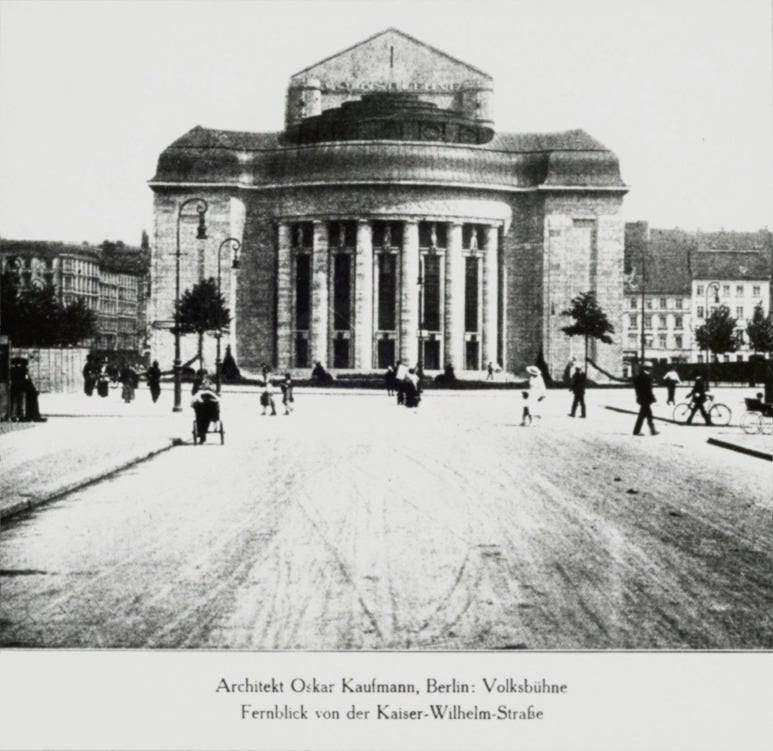
ALL WORLD'S A STAGE: THE VOLKSBÜHNE THEATRE IN SCHEUNENVIERTEL
Last week in Berlin: 30 December, 1914

You cannot pass it by and overlook it. The massive stone body of Berlin’s Volksbühne (“People’s Theatre”) casts an equally huge shadow over Rosa-Luxemburg-Platz and Linienstraße - both literally and metaphorically speaking.
The theatre building’s inauguration on December 30, 1914 might have been marred by annoying teething problems (the inauguration had to be postponed - twice - and after the rotating stage refused to rotate, that night’s programme had to be changed, too) but the birth as such was a social, cultural and political event of the decade.
The Volksbühne theatre would become the only large stage in Germany’s capital financed almost entirely through donations and membership fees - with the Arbeitergroschen or “workers’ pennies”. These were paid by members of the Freie Volksbühne Verein (Free People’s Theatre Association) established in 1890 to enable all social classes, and especially the working ones, to enjoy high culture.

Unlike today, where the theatre auditorium is traditionally filled with a healthy mix of various social groups (high curt judges sitting next to printers, nurses and supermarket cashiers), the late-nineteenth-century house of Thalia and Melpomene had two powerful gatekeepers: Money and Influence. Theatre going was something done for leisure and education, and remained firmly in the hand of aptly named leisure classes.
There was also the third gatekeeper preventing the less affluent from partaking in the theatre wonderland: Time. Working from the early hours of Monday until late hours of Saturday was hardly conducive to dates with Shakespeare or Schiller.

That is why the grounding principles of the Freie Volksbühne (which at an early point split into two factions whose leaders re-united again to realise the Volksbühne theatre project)- next to small membership fees and guaranteeing access to the theatres, included an important scheduling point: all plays would be presented on Sunday afternoon. To make sure that all members of the association could make it.
There was more. To make sure that the process of sitting the audience - people whose regular membership fees sustained the house - was as fair and as transparent as possible, the seating order was regulated in a simple and chance-based way: by having all theatre-ticketholders draw lottery tickets from an urn placed at the entrance.
There was only one exception - regarding the first row. However, despite what our instinct might be suggesting (in an absolutely understandable manner, seeing these places occupied by the VIPs), it was not reserved for the creme-de-la-creme. The first row of seats at the Volksbühne waited for all guests with visual impairments or hard of hearing.
The archive of the Freie Volksbühne association still holds a note provided by one of the guests to make sure she received a front-row location. A physician’s note confirming that Frau Frieda Schultze, his patient, must by all means get the first-row seat. Whether the note was written in good faith and whether Frau Schultze enjoyed the front-row view was, sadly, not recorded.

And here’s a small piece of Berlin trivia for your next pub quiz: two years before the Reichstag building got its inscription “Dem Deutschen Volke” (For the German People), the Volksbühne - designed for the Verein by the brilliant theatre-architect, Oskar Kaufmann - featured an equally apt inscription “Die Kunst Dem Volke” - Art for the People.
Thank you for reading Berlin Companion. As always, feel free to comment, follow and share!


Stunning historical piece! The lottery seating system and Sunday afternoon scheduling were genuinly revolutionary for democratizing culture. What strikes me most is how the Volksbühne didn't just lower economic barriers but actualy thought through every aspect—time, accessibility, even the visual/hearing impairment accomodations in 1914! That level of thoughtfulness feels rare even today. The architect Oskar Kaufmann clearly understood that the building itself had to embody the mission. I visited Rosa-Luxemburg-Platz last year and had no idea about this egalitarian history, dunno why it's not more widely celebrated.